About the Study
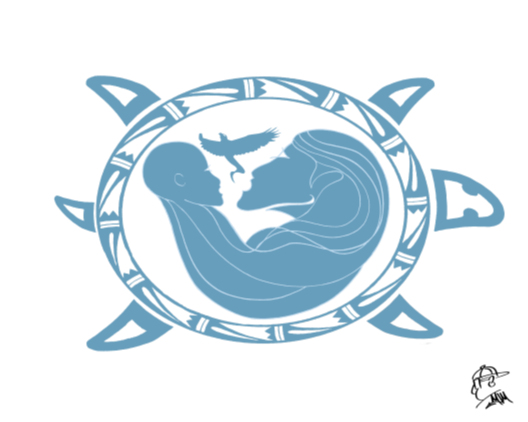
The Indigenous-Language Immersion (ILI) Study logo was created by Mike J. Marin (Navajo/Laguna Pueblo/Washoe), a self-taught artist and independent filmmaker. The design symbolizes motherhood and Native oral traditions, with the mother’s voice carried by the eagle, the turtle father representing creation stories and wisdom, and the Pueblo design evoking water and change. Beyond his artwork, Marin is the founder of Redgear Productions, a Native-themed apparel company, and the filmmaker behind The Smudging, continuing his creative journey in Los Angeles.
The Indigenous-Language Immersion and Native American Student Achievement Study, funded by the Spencer Foundation (2016-2023), examined Indigenous-language immersion (ILI) schooling, an approach in which all or most academic content is engaged through the Indigenous language (IL) with a strong culture-based curriculum. ILI approaches vary, but all aim to develop children’s IL proficiency, promote cultural knowledge and identity, and produce academic outcomes in parity with English-medium approaches. This multi-method, multi-university study provides the only U.S.-wide database on ILI schooling – its distinctive features and effects. The goal is to contribute to research, policy, and practice to improve education opportunities and outcomes for underserved Native American students. In doing so, the study illuminates promising practices that promote the holistic academic wellbeing of students from diverse linguistic and cultural communities.
American Indian, Alaska Native, and Native Hawaiian students face enduring academic disparities – the legacy of colonial schooling and federal policies intended to eradicate Indigenous languages and cultural practices. More than a third of K-12 Native American students attend high-poverty schools. The public school graduation rate for Native students is 75%, lower than any group in the U.S. At the same time, there is growing concern among Native Peoples about the loss of ancestral languages and knowledge systems. In response, many Native Peoples have developed innovative ILI programs. Prior to this study, there was no comprehensive database on these programs. This study provides that database.
The study demonstrates that ILI students progress at the same rate as or exceed their non-ILI peers academically, even on tests in English. Through relational, academically rigorous, culture-based pedagogies, ILI students learn and/or maintain their Indigenous language, develop positive identities, and cultivate respect and responsibility to their communities and the natural world. In the process, ILI strengthens family-school bonds and parent engagement. In doing so, the study illuminates promising practices that promote the holistic academic wellbeing of students from diverse linguistic and cultural communities.
Study Timeline
2016–2017 | Foundations and Partnerships
The study officially began with a $1 million grant from the Spencer Foundation of Chicago, Illinois. Yet, even before this, the research team reached out to a wide network of indigenous educators, community members, and scholars to ascertain the need for the study and the study design. Once funded, the study team secured Institutional Review Board (IRB) approvals and research agreements across three participating universities. Initial partnerships were established with Indigenous-language schools in Hawai‘i, Arizona, and the Navajo Nation. The team conducted its first site visits, and began formulating surveys and collaboration protocols grounded in respect, reciprocity, and relational accountability.
2017–2018 | Building Relationships and Instruments
The research team developed research agreements with eight Partner Schools serving Native Hawaiian, Mohawk, Navajo, and Ojibwe language communities. Each agreement reflected site-specific cultural and institutional protocols – from talking circles with teachers and parents, to formal MOUs, to state and school district permissions, to a Tribal IRB. Introductory site visits and community consultations laid the foundation for long-term partnerships, shaping a research model that centers Indigenous sovereignty and data sharing.
2018–2019 | Data Collection in Motion
The research team finalized the National and Parent Surveys to address RQ1 and RQ3. This was a period of intensive ethnographic fieldwork at the eight case study sites, from Hawai’i to New York. Data gathering included classroom observations, document collection, and in-depth interviews with teachers, parents, Elders, school leaders, and youth. A comprehensive national database of Indigenous-language programs was initiated to document the scope and diversity of ILI efforts nationwide.
2019–2020 | Integrating Data and Facing a Pandemic
Ethnographic fieldwork wrapped up in Hawai’i and expanded to Navajo, Mohawk, and Ojibwe schools. Facing a global COVID-19 pandemic, the team continued gathering qualitative and quantitative data through virtual meetings and collaboration with Partner Schools. The study’s quantitative matched-pair analysis was finalized, with initial datasets gathered to compare academic outcomes between ILI and English-medium students.
2020–2021 | Adapting and Deepening the Analysis
The pandemic slowed fieldwork, but the team continued to produce analytic memos and to undertake systematic qualitative data analysis. The research team strengthened virtual collaboration. By this time, the team had conducted over 30 site visits and refined methods to account for the pandemic’s impact on ILI programs.
2021–2022 | Symposium and Collaborative Knowledge Sharing
The 2-day ILI Study Capstone Symposium, held in July 2022 in Tovaangar, Tongva lands and waters, also known as Santa Monica, California, brought together educators, researchers, and community leaders from the Partner Schools. The National Coalition of Native American Language Schools and Programs (NCNALSP) and a member of the Hawai‘i Board of Education also participated. The event emphasized ILI’s relational pedagogy, community-based research, future collaborations, and action planning for dissemination and impact. This event was funded by a grant from the American Educational Research Association.
2022–2023 | Findings and Dissemination
The research team synthesized seven years of data from surveys, case studies, and the matched-pair analyses. Findings confirmed that ILI students perform on par with or better than carefully matched peers in English-medium programs, while demonstrating strong Indigenous-language proficiency and cultural identity. The team began initial dissemination of these findings at regional, national, and international conferences.
2024–2026 | Deepening Analysis and Expanding Dissemination
Although the study’s funding ended in 2023, the research continued with follow-up consultations and intensive data analysis. The team produced dissemination materials—including a Research Brief, Executive Summary, and US Senate testimony—and presented findings at conferences. The team also continued follow-up virtual and in-person meetings with participating sites to support collaborative interpretation and knowledge sharing.